Pillar 01
Research.
Five areas. Named leads. Work that carries student names.
The Institute's research is organized in five areas at the intersection of artificial intelligence, management, and organizations. Each area has a faculty lead. Doctoral students, early-career faculty, and undergraduate researchers work inside them.
The purpose of the research pillar is to make the faculty visible as one group rather than a collection of separate agendas, and to give organizations one place to find the people already studying the question they are living with.
Stance
Sociotechnical and design-oriented, applied to adoption, transformation, governance, and impact. Augmentation over automation, agency over abdication, human judgment at the center.
Areas of focus.
Scaling Intelligence in Organizations
Artificial intelligence is raising the cognitive capability of individual employees faster than any previous technology. Organizational intelligence, meaning the quality of a firm's decisions, the rate at which it learns, and its ability to change direction, is not rising at the same pace, and in some organizations it is falling. This research asks why rising individual capability is not compounding into collective capability, and what leaders can do about it.
Validation and Verification of Intelligent Systems
The validation of a system, ensuring it meets the needs of the use function, and the verification, confirming that the system executes as per the design specification, are foundational to all software. The Institute examines what validation and verification mean for machine learning and for hybrid systems that combine neural and symbolic approaches.
Theory and Application of Blockchain
Blockchain technologies have evolved into a global infrastructure, comprising tokens, miners, smart contracts, and regulation. The Institute uses South Florida's position as a financial technology hub to build theory and case research on how that infrastructure is governed and used.
Emerging Technologies
Digital platforms, machine learning in production, quantum computing, and the strategic adoption of new technology across business contexts.
Ethics of Systems and Human Interaction
Central to human-centric computing is the ethical basis of systems, their use, and their applicability. The work addresses fairness, the effect on labor, and the dilemmas that autonomous systems create in critical infrastructure.
Who does the work
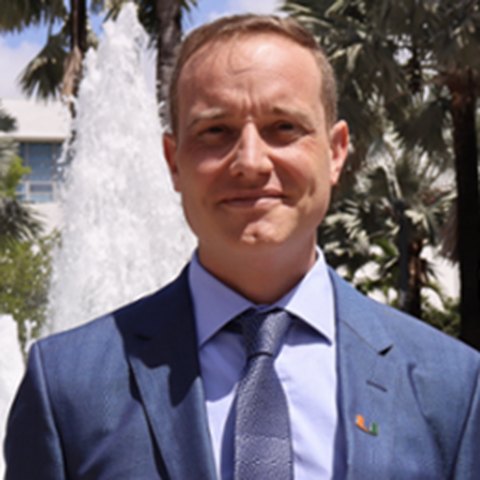
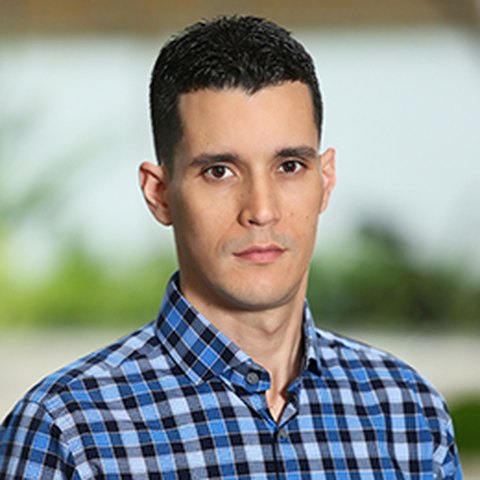
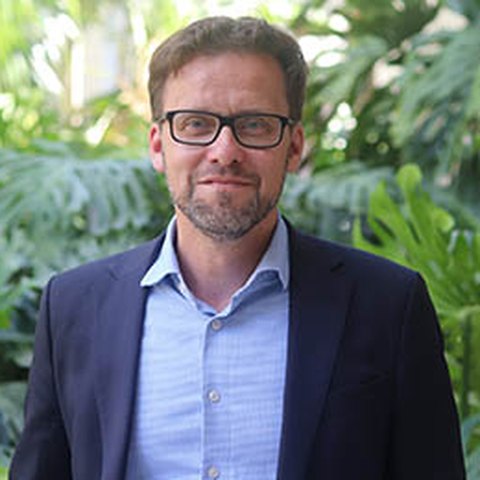
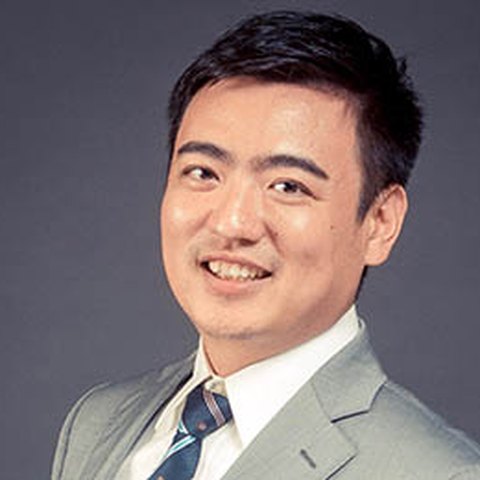
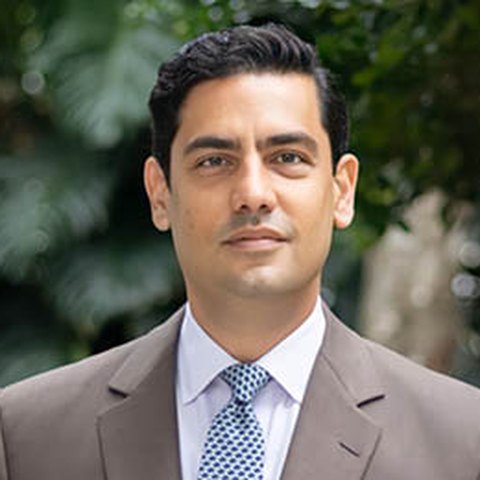
Research at the Institute is led by faculty of the Department of Business Technology and colleagues across the school, including Ola Henfridsson, Robert W. Gregory, Kevin Hong, Nina Huang, Maikel Leon Espinosa, and Niam Yaraghi.

Undergraduateresearch.
Sponsor a project →Business undergraduates at the Institute do research, not coursework about research. They work with a faculty lead on a real question, for a full semester, and the work goes out under their own names.
The program runs in two tracks. AI Fellows is the donor-supported track, where students pursue a research question with a faculty mentor and submit the result to a peer-reviewed venue. Sponsored projects is the industry track, where a company brings the question and the context, and the same structure produces research the sponsor can act on. The Institute's undergraduate research initiatives are led by Maikel Leon Espinosa, AI Institute Fellow.
Published · Spring 2026
Two undergraduate business students, two IEEE papers
Both AI Fellows papers submitted in April 2026 were accepted to the IEEE Opportunity Research Scholars Symposium and published in the proceedings on IEEE Xplore. Undergraduate business students with peer-reviewed machine learning papers is an unusual claim, and it is the program's first published output under the Institute's current leadership.
The papers
Non-Stationary Spectral Decomposition Network: Adaptive Spectral Emission Heads and Frequency Modulation.
Nikhil Sunder · IEEE ORSS 2026
Auditing Abliteration: Normalization Placement, Edit Budget, and Transfer in Single-Direction Refusal Removal.
Charlie Tucker · IEEE ORSS 2026
| № | Term | Track | Area | Title | Outcome |
|---|---|---|---|---|---|
| 26-02 | Sp26 | AI Fellows | Machine learning / signal processing | Non-Stationary Spectral Decomposition Network: Adaptive Spectral Emission Heads and Frequency Modulation | IEEE ORSS 2026 · IEEE Xplore |
| 26-01 | Sp26 | AI Fellows | Model safety / alignment | Auditing Abliteration: Normalization Placement, Edit Budget, and Transfer in Single-Direction Refusal Removal | IEEE ORSS 2026 · IEEE Xplore |
| 27-01 | Sp27 | Sponsored | Open to sponsors | Company-sponsored research project, Spring 2027 | Accepting proposals |
How a sponsoredproject runs.
Three phases across one academic term. A sponsor brings the question and the context. The Institute brings the faculty lead, the student research team, and the research standard.
Scoping
- 01Conversation with the faculty lead about the question the organization is actually confronting
- 02Research question written down in a form that can be answered in one term
- 03Data availability and access agreed, in writing
- 04Institutional review board approval secured before any data is collected
- 05Confidentiality, publication rights, and student credit settled up front
Research
- 01Student research team matched to the question and the method
- 02Faculty lead supervises weekly; the Institute reviews at milestones
- 03Sponsor check-ins on a fixed cadence, not on demand
- 04Analysis run against the sponsor's own data or context
- 05Findings presented to the sponsor's leadership at the end of the term
Publication and handoff
- 01Written findings the sponsor can act on, not a slide deck
- 02Paper prepared for a peer-reviewed venue, students as authors
- 03Sponsor review of anything identifying, before submission
- 04Students presented to the sponsor as candidates, if the fit is there
- 05Option to continue the question into a following term
Publications
Selected work
Faculty of the Institute publish in the Academy of Management Review, MIS Quarterly, Information Systems Research, Production and Operations Management, the Journal of Management Information Systems, MIT Sloan Management Review, and the Journal of the Association for Information Systems.
Speaker series
Seminars and visitors
The Institute hosts a speaker series bringing researchers and practitioners to Coral Gables during the academic year, open to the University community. Upcoming sessions are announced ahead of each term.
Sponsor a researchproject.
One question, one term, a faculty lead and a student research team. Sponsored projects for Spring 2027 are being scoped now, and scoping starts three to four weeks before the term does.